Largemouth Bass: How to Identify Them, Where They Live and How to Catch Them
The most popular game fish in the US is easy to recognize once you know the jaw and the stripe. Here's where largemouth live, what they eat and how they move through the year.
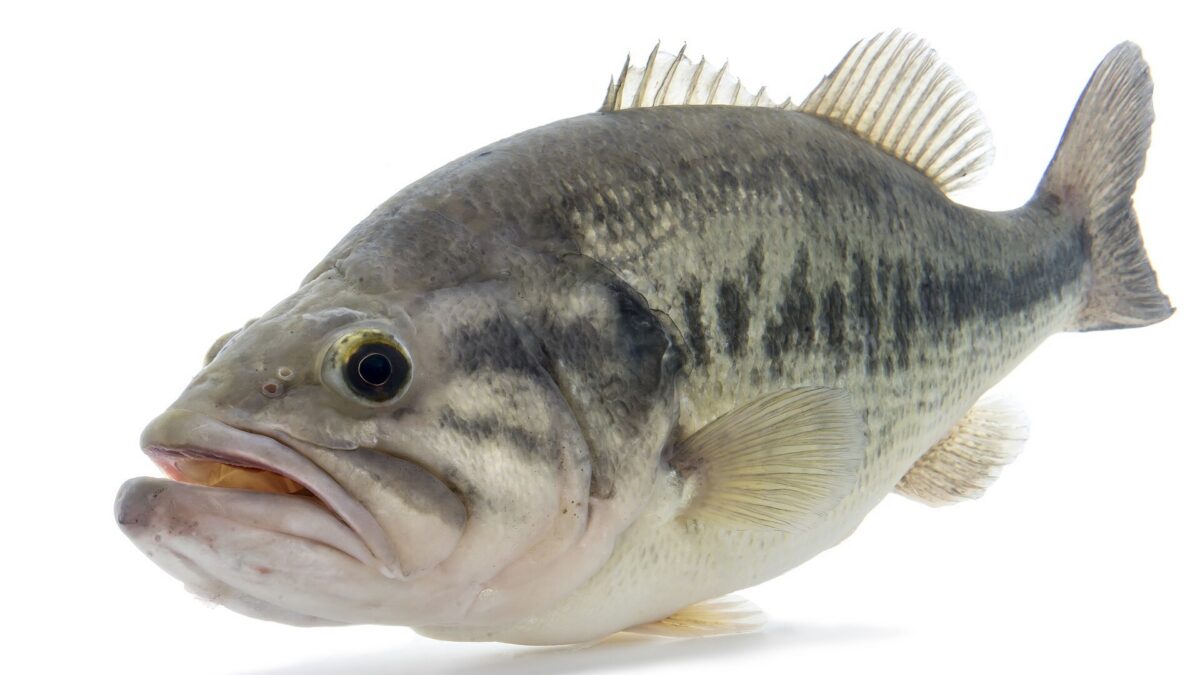
The largemouth bass is a green, heavy-bodied sunfish with a dark horizontal stripe and an upper jaw that reaches past the back of the eye. It lives in almost every kind of warm, still or slow water in the lower 48 states, from farm ponds to big reservoirs, and it eats whatever it can fit in its mouth. To catch one, fish near cover such as weeds, wood and docks with a soft plastic worm, a spinnerbait or a topwater lure, and adjust depth with the seasons.
How to identify a largemouth bass
Largemouth, smallmouth and spotted bass all belong to the black bass group (genus Micropterus) and can look alike at first glance. These are the features that settle it:
- The jaw. With the mouth closed, the upper jaw of an adult largemouth extends past the rear edge of the eye. On smallmouth and spotted bass it stops around the middle or the back of the eye.
- The stripe. A broad, dark band runs along the side, often broken into blotches. Smallmouth have vertical bars instead.
- The dorsal fin. The spiny and soft parts of the dorsal fin are separated by a deep notch, so they look almost like two fins. On smallmouth and spotted bass the two parts are more clearly joined.
- The tongue. Largemouth usually have no tooth patch on the tongue. Spotted bass usually do, which is the quickest check when you can’t tell the two apart.
- Color. Usually green to olive on the back with a lighter belly. Fish from muddy or tannic water can look pale or brownish, so don’t rely on color alone.
For a side-by-side comparison, see our guides to largemouth vs smallmouth bass and how to tell a spotted bass from a largemouth.
Florida bass and northern largemouth
Biologists long treated the Florida bass as a subspecies of largemouth. Genetic work published in 2022 supported splitting them into two species, and some agencies have since updated their names: the U.S. Geological Survey now lists the largemouth as Micropterus nigricans, and Florida’s wildlife commission recognizes the Florida bass, native to Florida and parts of Georgia and the Carolinas, as its own species. For anglers little changes: the fish look the same, they hybridize where both have been stocked, and regulations generally treat them as one “largemouth bass.” Florida-strain fish are the reason many Southern and California lakes produce very large bass.
Where largemouth bass live
The native range covers the Great Lakes and St. Lawrence region, the Mississippi River basin south to the Gulf, and Atlantic drainages from North Carolina to Florida. Stocking has spread them across nearly the whole country, so there is probably a largemouth fishery within a short drive of you. The USGS fact sheet has range maps and identification details.
They do best in warm, fairly clear to stained water with plenty of cover:
- Ponds and small lakes: weed edges, lily pads, overhanging trees, the dam and any inflow.
- Natural lakes: weedlines, docks, reed beds and the drop-off where the shallow flat meets deeper water.
- Reservoirs: creek arms, flooded timber, points, riprap, docks and old river channels.
- Rivers: backwaters, sloughs and slack water out of the main current. Smallmouth and spotted bass usually take the faster, rockier water.
Largemouth are ambush predators. Cover gives them a place to hide and a way to surprise prey, which is why the same stump or dock can hold fish year after year.
What largemouth bass eat
Young bass start on tiny crustaceans and insects and become fish-eaters within their first season. Adults eat other fish (shad, bluegill and other sunfish, perch, minnows), crayfish and frogs, and occasionally snakes, mice, small birds and smaller bass. They will take prey up to a surprisingly large size, which is one reason big lures catch big fish. Our guide to what bass eat by season covers how to match lures to the local forage.
Where to find largemouth through the year
Water temperature drives most of their movements. The ranges below are typical; timing shifts by weeks between Florida and Minnesota, and between shallow ponds and deep reservoirs.
| Season | Typical water temperature | Where bass usually are |
|---|---|---|
| Winter | Below about 50°F | Deeper water near the steepest drops, channel bends, deep docks; slow and less active |
| Pre-spawn | About 50–60°F | Moving toward spawning flats; staging on points, secondary points and the first drop near shallow bays |
| Spawn | About 60–75°F | Shallow nests (often 1–4 feet) on firm bottom in protected pockets |
| Post-spawn | Upper 60s–70s°F | Recovering near the spawning areas, docks and the first weedline; topwater bite often starts |
| Summer | 75°F and up | Shade, thick vegetation, deeper points, ledges and humps; shallow at dawn, dusk and night |
| Fall | Cooling from about 75°F to 55°F | Following baitfish into creek arms and onto flats; often roaming and feeding heavily |
During the spawn, the male fans out a nest roughly the size of a pizza and guards the eggs and the young fry. If you fish for bedding bass, check whether your state has a spawning-season closure or catch-and-release rule, and release nesting fish quickly near where you caught them.
Basic ways to catch largemouth bass
You don’t need a boat full of tackle. A medium or medium-heavy rod around 7 feet and a handful of proven lures cover most situations:
- Soft plastic worm (Texas-rigged): weedless, works in cover at any depth and any season.
- Wacky-rigged stick bait: a weightless or lightly weighted worm that falls slowly; good for pressured or post-spawn fish.
- Spinnerbait: flash and vibration for stained water, wind and covering water along banks.
- Crankbait: square-bill models for shallow cover, deeper divers for points and ledges.
- Topwater: poppers, walking baits and hollow-body frogs at low light and over grass in summer and early fall.
- Jig: a bulky, crawfish-like bait for heavy cover and bigger fish.
Our step-by-step guide on how to catch largemouth bass explains how to work each lure and set the hook.
Size, growth and records
Largemouth grow faster and larger in the South, where the growing season is longer. A fish around 16 inches is a common size in many waters, and anything over 5 pounds is a good fish almost everywhere. The all-tackle world record is shared: George Perry’s 22-pound, 4-ounce bass from Montgomery Lake, Georgia, in 1932, and Manabu Kurita’s fish from Lake Biwa, Japan, in 2009, which the International Game Fish Association certified as a tie.
Rules and licenses
Size limits, daily bag limits, slot limits and spawning-season rules for bass vary by state and often by individual lake. Most states require adults to carry a fishing license; the age when it applies and the exemptions differ. Check your state wildlife agency’s current regulations before you go, and buy your license online through the agency or a licensed agent (see Take Me Fishing’s license page for links by state).
Bottom line
A largemouth is the black bass with the big jaw that reaches past the eye, a dark side stripe and a deeply notched dorsal fin. It lives in ponds, lakes, reservoirs and slow rivers nearly everywhere in the US, relates to cover, and follows water temperature from deep winter haunts to shallow spring nests and back. Fish cover with a Texas-rigged worm, a spinnerbait or a topwater lure, adjust depth with the season, and you’ll be fishing where most bass live.
FAQ
How can I quickly tell a largemouth from a smallmouth?
Close the fish’s mouth and look at the jaw. On a largemouth the upper jaw extends past the back of the eye; on a smallmouth it stops around the middle of the eye. Largemouth also have a dark horizontal stripe, while smallmouth have vertical bars.
How big do largemouth bass get?
Most bass anglers catch weigh a few pounds or less. Fish over 10 pounds are rare in most of the country; the biggest usually come from Southern and Western waters with Florida-strain genetics. The world record is 22 pounds, 4 ounces, shared by George Perry (1932) and Manabu Kurita (2009).
What is the best time of year to catch largemouth bass?
Spring (pre-spawn) and fall are usually the easiest, because bass are shallow and feeding heavily. Summer is good at dawn, dusk and at night; winter fishing works but requires slow presentations in deeper water.
Are Florida bass and largemouth bass the same fish?
They are now widely treated as two closely related species, but they look identical, interbreed where stocked, and most regulations group them together as largemouth bass.